
The short answer
An AC-coupled battery sits alongside your existing solar inverter, so your panels and inverter stay as they are. It’s usually the simplest way to add storage to a system that works well. A DC-coupled battery runs through a hybrid inverter that handles both the panels and the battery. It’s slightly more efficient, and it makes sense when your inverter is old, failing or being replaced anyway. Both work well: your inverter usually decides.
If you already have solar panels and want to keep more of what they make, you’ll soon hear “AC coupled”, “DC coupled” and “hybrid inverter”. They describe where the battery joins your system. Here’s what each means, in plain terms, and how to tell which suits your home.
What do AC coupled and DC coupled mean?
Your panels make direct current (DC). Your home runs on alternating current (AC). Batteries store DC. So somewhere, the electricity has to be converted, and “coupling” is about where the battery plugs into that chain.
AC-coupled
The battery comes with its own inverter and connects on the AC side, near your consumer unit, alongside the solar inverter you already have. Your solar inverter keeps turning the panels’ DC into AC. When there’s more than the house needs, the battery’s inverter turns that surplus back into DC to store it, then into AC again when you use it in the evening.
DC-coupled, through a hybrid inverter
One hybrid inverter takes both the panels and the battery. Solar goes into the battery as DC and is converted to AC once, when you use it. All our new solar and battery packages work this way.
What is a hybrid inverter?
An inverter with connections for both panels and a battery. Some hybrids can also be set up AC-coupled: Fox ESS’s H1-G2, for example, works either way.
Is AC coupling less efficient?
A little, for the solar that goes through the battery. Every conversion between AC and DC loses a small amount of energy as heat, and AC coupling converts stored solar more times. Solar you use straight away, while the sun is out, isn’t affected at all.
So yes, on paper DC coupling wins. But the bigger gain from either is storing your midday surplus for the evening instead of exporting it cheaply. A small conversion loss is rarely a reason to replace an inverter that works.
Why AC coupling is often simplest for a retrofit
- Nothing on the roof changes. Your panels and their wiring stay exactly as they are.
- Your inverter keeps working. A healthy inverter isn’t thrown away for the sake of it.
- Fewer changes to the generation side. Helpful if you’re on the older Feed-in Tariff (more on that below).
- Brand freedom. The battery doesn’t need to match your inverter’s make.
Our guide to adding a battery to existing solar walks through the whole process.
When swapping to a hybrid inverter makes sense
- Your inverter is old, failing or out of warranty. If it needs replacing soon anyway, replace it once, with a hybrid.
- You’re adding more panels. New panels and a battery on one hybrid inverter is a clean design, and the scaffolding only goes up once.
- The battery you want is a hybrid. EcoFlow, Anker and Hanchu all run through their own hybrid inverters.
- You want everything in one app, from the panels to the battery.
What about the Feed-in Tariff?
If you’re on the older Feed-in Tariff, tell us at the start: we design the battery so it doesn’t affect how your generation meter reads. Your Feed-in Tariff payments are based on that meter, so where and how the battery connects matters, and it’s one of the first things we check. If you’re on the Smart Export Guarantee instead, you keep your export arrangement too.
AC vs DC coupled at a glance
Where the battery joins
AC-coupled: On the AC side, alongside your solar inverter
DC-coupled (hybrid): On the DC side, through one hybrid inverter
Your existing inverter
AC-coupled: Stays where it is
DC-coupled (hybrid): Replaced by the hybrid inverter
Stored solar
AC-coupled: Converted DC to AC, back to DC, then to AC again
DC-coupled (hybrid): Stored as DC, converted to AC once when you use it
Efficiency
AC-coupled: A little lower for solar that goes through the battery
DC-coupled (hybrid): A little higher for solar that goes through the battery
Disruption
AC-coupled: Panels and inverter left as they are
DC-coupled (hybrid): Panels rewired to the new inverter
Usually best when
AC-coupled: Your system works well and the inverter is healthy
DC-coupled (hybrid): The inverter is old or failing, or you're adding panels
Batteries we fit
AC-coupled: Fox ESS (AC-coupled inverter), Sigenergy SigenStor, Canadian Solar EP Cube
DC-coupled (hybrid): EcoFlow PowerOcean, Anker SOLIX X1, Hanchu ESS, plus Fox, Sigenergy and EP Cube
Battery types as stated by each manufacturer in October 2026. We check your system before recommending anything.
Which of the batteries we fit are AC-coupled?
We only list what each manufacturer confirms:
- Fox ESS: yes. Fox makes the AC1-G2, a dedicated AC-coupled inverter for adding storage to existing solar, and its H1-G2 hybrid works either way. See Fox ESS.
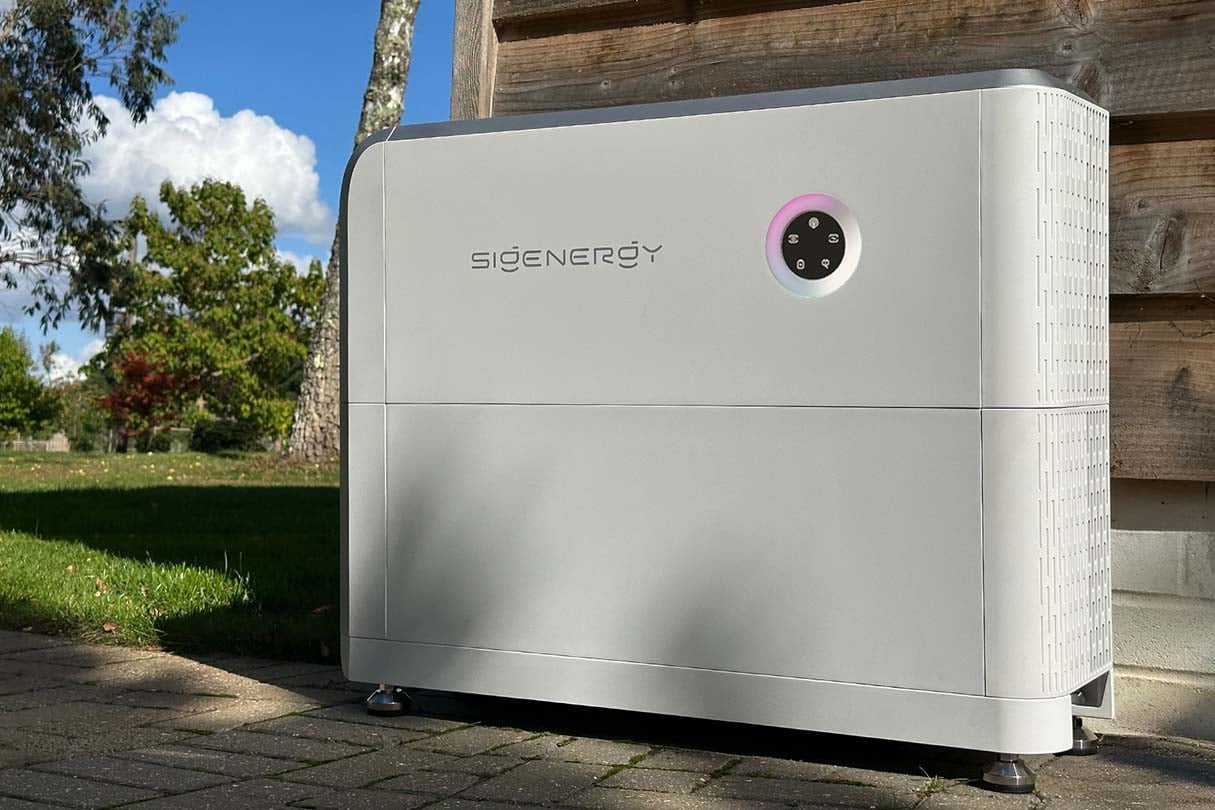
- Sigenergy SigenStor: both. It’s a hybrid on a new install, and Sigenergy publishes an AC-coupled retrofit set-up that leaves your existing inverter in place. See Sigenergy.
- Canadian Solar EP Cube: both. It supports AC and DC coupling and works with existing solar systems and other brands’ inverters. See EP Cube.
- EcoFlow PowerOcean: a hybrid. For a house with panels, the usual route is replacing your inverter with EcoFlow’s.
- Anker SOLIX X1: a hybrid with its own solar inputs. Anker says solar from another brand can still charge it through its Power Dock Pro, even in a power cut; we confirm how that works for your system.
- Hanchu ESS: a hybrid. For existing panels it usually replaces your inverter.
What we check first
Your inverter’s make, model and age; whether you’re paid through the Feed-in Tariff or the Smart Export Guarantee; where the battery can go; and whether your consumer unit has room. Adding storage changes what your home can export, so the network operator (DNO) needs to know, and we handle that. A battery added to existing panels is 0% VAT until 31 March 2027. Send us a photo of your inverter and we’ll tell you which route fits: see adding a battery to your existing panels.
Our verdict
If your system works well and your inverter is healthy, AC coupling is usually the simplest, least disruptive way to add a battery. If the inverter is old or failing, or you’re adding panels anyway, a hybrid inverter is worth the change. Either way, our technical solar designer will look at your current set-up and talk you through both options on a video call before you decide.