The short answer
Yes. Sigenergy SigenStor is one of the two batteries we recommend most. It combines a hybrid inverter, LFP battery modules rated for 10,000 cycles, optional DC EV charging and 0 ms whole-home backup (with its gateway) in one stackable, IP66 system. The trade-offs: it costs more than simpler batteries, it’s a young brand, and the warranty depends on the system staying online.
Sigenergy is the battery brand we’re asked about most, and the questions are usually the same ones. Here they are, answered plainly by an installer that fits it.
Is Sigenergy any good?
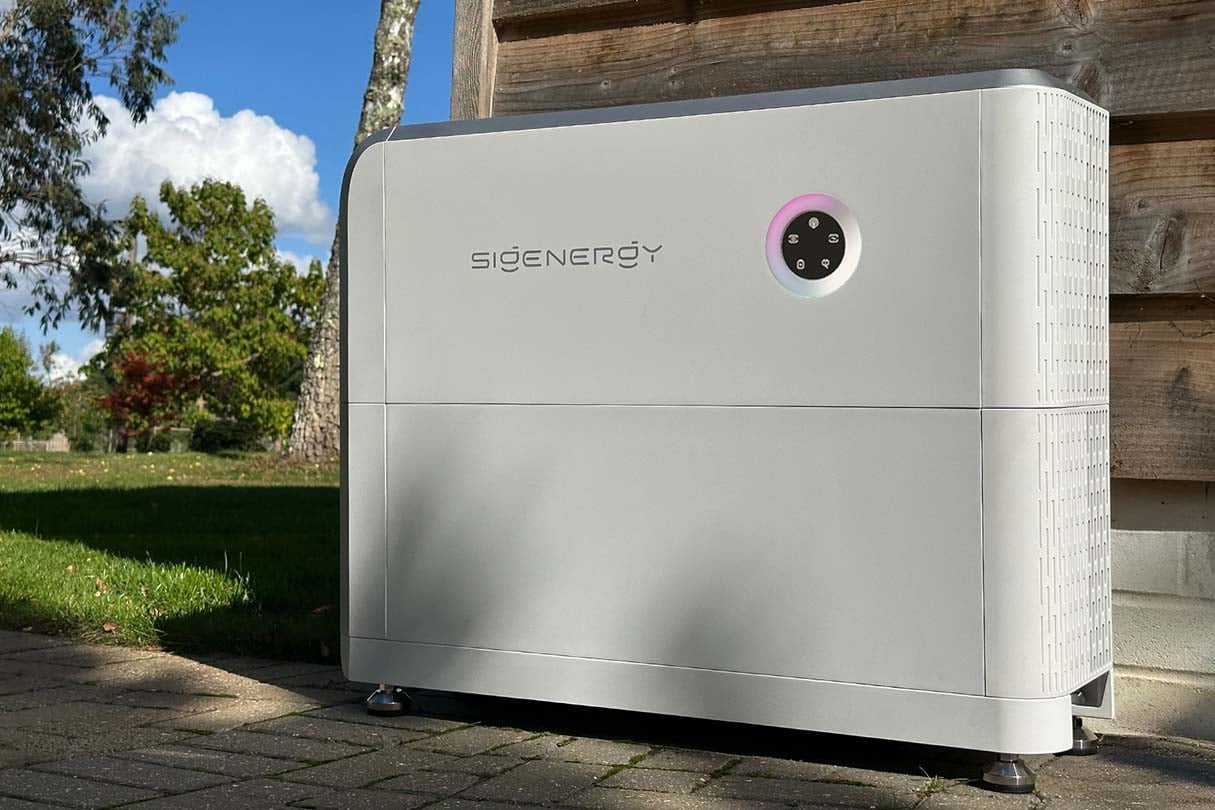
On the hardware, yes. A SigenStor is a stack: an Energy Controller (the inverter) at the bottom, then one to six battery modules of 6 or 9 kWh, up to about 54 kWh. The cells are lithium iron phosphate, the stable chemistry most home batteries now use. The controller runs from 3 to 12 kW on a single-phase supply and 5 to 30 kW on three phase, so it suits small homes and very big ones.
Where it stands out:
- EV charging built in. An optional DC charging module sits in the stack.
- 0 ms backup. With the Sigen Energy Gateway, the whole house stays on when the grid drops, with no flicker.
- One app. mySigen plans charging around your tariff, the weather forecast and your usage.
- Room to grow. Add modules later without changing the system.
Where it is weaker:
- Price. It usually costs more than Fox ESS or Hanchu, especially with the gateway and EV module.
- Track record. Sigenergy was founded in 2022, so it has fewer years in the field than older brands.
- Backup is an extra. Whole-home backup needs the separate gateway.
Is Sigenergy Chinese?
Yes. Sigenergy Technology Co., Ltd. is a Chinese company. Its global headquarters, research centre and factory are in Shanghai. It was founded in 2022 by Tony Xu, previously of Huawei’s solar business, and listed on the Hong Kong Stock Exchange in April 2026. It sells across Europe and Australia as well as the UK.
Many of the leading home battery brands are Chinese, Fox ESS among them. What matters more day to day is the warranty terms, how the system is supported in the UK, and who installs it.
Does Sigenergy work with Octopus?
Octopus lists Sigenergy as compatible with its smart battery products. It is “eligible right now” for Charge Pack, Octopus’s add-on that runs your battery automatically if you are on Intelligent Octopus Go, Octopus Go, Flexible or Fixed for import and Outgoing Octopus for export. Sigenergy is also on Octopus’s list for Intelligent Octopus Flux, though at the time of writing Octopus says that tariff is only open to customers who bought their solar and battery from Octopus.
On any other time-of-use tariff, the mySigen app can charge the battery on cheap rates and use it at peak times. See our guide to the best tariffs for solar and batteries.
Is SigenStor AC or DC coupled?
SigenStor is a DC-coupled hybrid. Your panels plug into the Energy Controller (it has two to four solar inputs, or MPPTs) and the battery modules stack on the same controller, so solar charges the battery directly on the DC side without converting to AC and back. That’s slightly more efficient than an AC-coupled battery, which sits alongside a separate solar inverter. If you want the difference explained, our guide to adding a battery to solar covers both.
Can Sigenergy be added to existing solar panels?
Often, yes. The usual route is to replace your existing solar inverter with the Sigenergy Energy Controller, which then runs both your panels and the battery. That works well if your inverter is old or out of warranty, or you also want EV charging or backup.
If your inverter is fairly new and you’d rather keep it, an AC-coupled battery such as Fox ESS may be the simpler job. Either way, we check your inverter, panels and wiring before recommending anything. A battery added to existing panels is currently 0% VAT, until 31 March 2027.
How long does a Sigenergy battery last?
Sigenergy rates its cells for 10,000 charge cycles, but the number that protects you is the warranty. In plain terms:
- 10 years as standard on the battery modules and the Energy Controller.
- Capacity guarantee. The battery should keep at least 60% of its usable capacity for those 10 years, or until it has delivered a set amount of energy, whichever comes first.
- Optional extension to 15 years, bought separately within 12 months of the system going live.
- Keep it online. The system must stay connected to the internet for updates. If it’s offline for more than a year in total, Sigenergy cuts the cover to five years.
- The EV DC module has a shorter, 3-year warranty.
Can a Sigenergy battery go outside?
Yes. SigenStor is rated IP66, so it can go on an outside wall or the floor outside, as well as in a garage or utility room. Sigenergy’s warranty asks for the surrounding temperature to stay between minus 20°C and 55°C, and it recommends 10°C to 30°C for the longest life. In practice, a shaded wall or a garage beats a spot in full afternoon sun.
Can SigenStor charge an electric car?
Yes, with the optional DC charging module, rated 12.5 or 25 kW, which slots into the stack. The car can charge straight from your panels and battery, without a separate wall charger. Sigenergy designs it for vehicle-to-home and vehicle-to-grid too, but that depends on your car supporting it and will arrive as a software update once the standards are in place. Prefer a standard wall charger? We fit those as well: see EV charger installation.
Is Sigenergy worth the extra cost?
It is if one or more of these is true:
- You have an electric car, or one is coming.
- You want the whole house to stay on in a power cut with no break.
- You use a lot of electricity, have a heat pump, or want room to go well past 15 kWh.
If you mainly want to store daytime solar for the evening, you may not need it. Fox ESS or Hanchu can do that job well for less. Compare them in Sigenergy vs Fox ESS, see how it stacks up against our other top pick in Sigenergy vs EcoFlow, or read which battery brand suits you.
Our view
Sigenergy is a genuinely capable system and one of our top two picks, especially for EV owners and bigger homes. It isn’t the cheapest way to store solar, and it doesn’t need to be. Our technical solar designer will design it for your roof on a video call, alongside a simpler option, so you can see whether the extra is worth it for you.