
The short answer
Both are excellent batteries and we recommend both. Choose Sigenergy SigenStor if you drive an electric car (or will soon), use a lot of electricity, or want room to grow well past 15 kWh: it is the only one of the two with EV charging built in. Choose EcoFlow PowerOcean if you want backup for your essential circuits built in, a 15-year warranty as standard on its 5 kWh packs, and a straightforward set-up.
Sigenergy and EcoFlow are our two top picks, and they’re often the last two left when someone has done their research. On paper they look similar: modular LFP batteries, hybrid inverters, smart apps. In a real home the differences matter, so here is how they compare and who each one suits.
Sigenergy vs EcoFlow at a glance
Battery modules
Sigenergy: 6 kWh and 9 kWh
EcoFlow: 5 kWh and 8 kWh
Most storage on one inverter
Sigenergy: Up to 6 modules, about 54 kWh
EcoFlow: Up to 48 kWh
Inverter sizes
Sigenergy: 3 to 12 kW single phase, 5 to 30 kW three phase
EcoFlow: 3, 5 or 6 kVA single phase (bigger Plus and three-phase models)
Battery chemistry
Sigenergy: LFP (lithium iron phosphate)
EcoFlow: LFP (lithium iron phosphate)
Rated cell cycles
Sigenergy: 10,000
EcoFlow: 10,000
Warranty
Sigenergy: 10 years, paid extension to 15
EcoFlow: 15 years on 5 kWh packs, 10 years (extendable) on 8 kWh
Power-cut backup
Sigenergy: 0 ms whole-home, with the Sigen Energy Gateway
EcoFlow: Built in for essential circuits; whole-home with the EcoFlow Gateway
EV charging
Sigenergy: Built-in DC charging module, 12.5 or 25 kW
EcoFlow: Not built in (separate AC charger available)
Indoor or outdoor
Sigenergy: Either, IP66
EcoFlow: Either, battery IP66
App
Sigenergy: mySigen, with AI energy management
EcoFlow: EcoFlow app, 500+ dynamic tariffs
Checked against Sigenergy’s and EcoFlow’s UK product pages and datasheets in October 2026. Manufacturers update their ranges, so we confirm the exact model and warranty in your quote.
What they have in common
- Safe battery chemistry. Both use lithium iron phosphate (LFP) cells, the chemistry most home batteries now use because it’s stable and long-lasting.
- Modular. You start with the storage you need and add modules later, without replacing the system.
- Hybrid inverter included. Your panels and battery run through one inverter, so solar charges the battery directly.
- Smart tariffs. Both apps can charge the battery on cheap overnight rates and use it at peak times.
- Inside or outside. Both are weatherproof, so a garage wall or an outside wall both work.
- Long-life cells. Both makers rate their cells for 10,000 charge cycles.
Where Sigenergy SigenStor is stronger
EV charging in the same stack
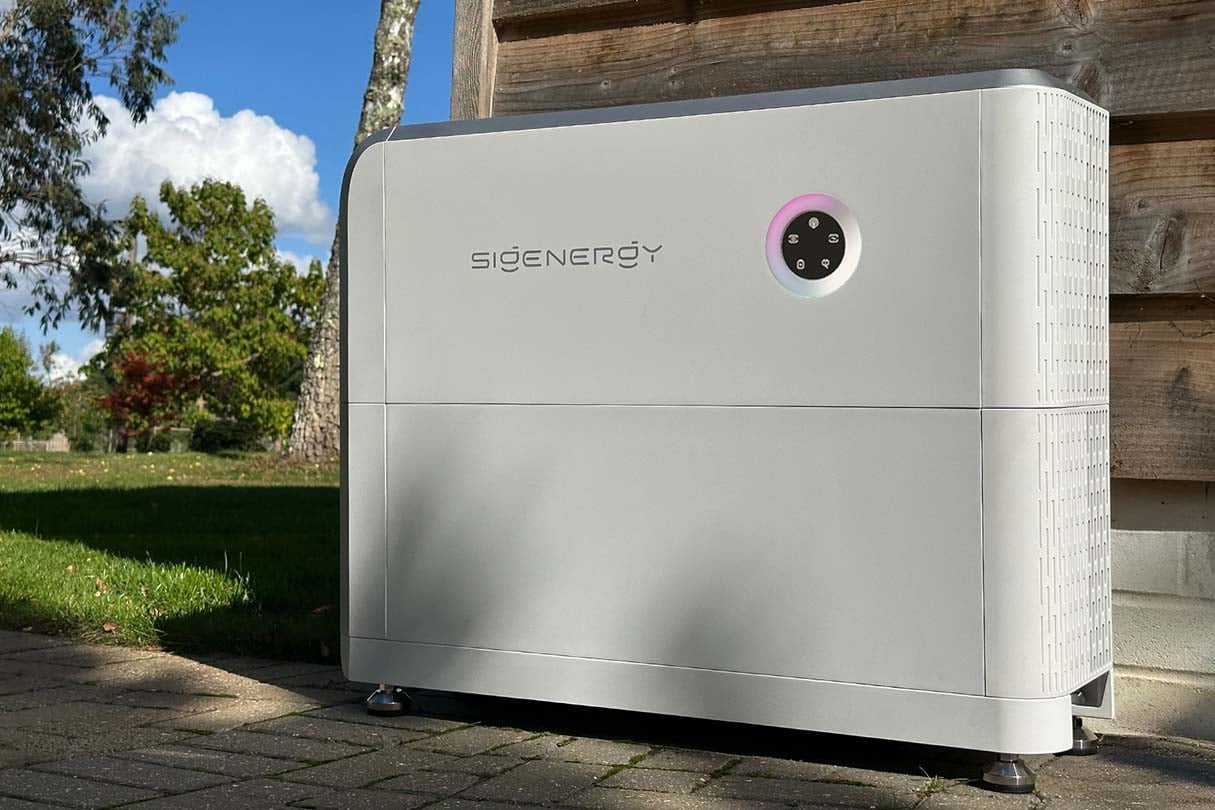
Sigenergy’s party trick is a DC EV charging module (12.5 or 25 kW) that slots into the battery stack. Your car can charge straight from the roof and the battery, without a separate charger on the wall. It is also designed for vehicle-to-home and vehicle-to-grid, which depends on your car supporting it.
More headroom
Single-phase inverters run from 3 kW to 12 kW, and one stack takes up to six modules, around 54 kWh. For a big house, a heat pump, an EV, or a three-phase supply, Sigenergy has the most room to grow.
One integrated system
Inverter, battery, energy management and EV charging come from one maker and run in one app, mySigen, which uses AI to plan charging around your tariff, the weather forecast and your usage.
Where EcoFlow PowerOcean is stronger
Backup built in
If the grid goes down, the OCEAN 2 keeps your essential circuits running with nothing extra to fit, up to what its inverter can supply. Sigenergy’s backup comes through its Sigen Energy Gateway. For the whole house, both use a gateway: the Sigen Energy Gateway or the EcoFlow Gateway. If you just want the fridge, lights and router to stay on in a cut, EcoFlow is the simpler way to get it.
15-year warranty as standard
EcoFlow’s 5 kWh packs come with 15 years as standard. Sigenergy gives 10 years, with a paid extension to 15. (EcoFlow’s bigger 8 kWh pack is 10 years, with an optional extension.) Like most battery warranties, both guarantee a minimum share of the original capacity over that time, so read the small print on any battery you compare.
Simple to live with
The EcoFlow app works with more than 500 dynamic electricity tariffs and keeps things simple. If you want a battery that just gets on with it, it’s a strong pick, and it still scales up to 48 kWh on one inverter.
Which one suits your home?
- You have an EV, or one is coming: Sigenergy. Built-in DC charging is the deciding feature.
- You want the essentials kept on in a power cut: EcoFlow, because that backup is built in. For the whole house, either works with its gateway.
- Big usage, a heat pump or a three-phase supply: Sigenergy, for the bigger inverters and capacity.
- You want the longest standard warranty and the least fuss: EcoFlow.
- The budget is tight: you may not need either. Fox ESS or Hanchu cost less and are good batteries. See which battery brand suits you.
What about cost?
We don’t quote shelf prices, because the right size depends on your roof, your usage and your tariff. With Sigenergy, the EV module and the backup gateway are optional extras, so the price depends on which you need. Either way, we design the system remotely and confirm the price after a free survey. A battery added to existing panels is currently 0% VAT, until 31 March 2027.
Our verdict
There’s no wrong answer between these two. If an electric car is part of your plans, Sigenergy is the one to beat. If you want backup, a long warranty and simplicity, EcoFlow is hard to fault. Our technical solar designer can design both for your roof and show you the numbers side by side before you decide.
More detail on each: Sigenergy SigenStor and EcoFlow PowerOcean.