
The short answer
Yes, the Anker SOLIX X1 is a good home battery, and it’s at its best where space is tight or the battery has to live somewhere cold. It’s 15 cm deep, holds 5 to 30 kWh of 5 kWh packs on one power module, runs down to −20 °C and has a 10-year warranty. Whole-home backup needs Anker’s Power Dock Pro, and the warranty is shorter than EcoFlow’s on its 5 kWh packs, so it’s worth comparing before you choose.
The SOLIX X1 is Anker’s home battery system: a slim power module (the hybrid inverter) with battery packs stacked beneath it. These are the questions we’re asked most about it, answered from Anker’s UK product page, datasheet and warranty terms.
Is the Anker SOLIX X1 any good?
Yes. What stands out:
- Slim. The whole stack is 15 cm deep.
- Each pack works on its own. Every battery has its own energy optimiser, so one weaker pack doesn’t hold the others back, and Anker says a faulty pack switches itself off while the rest keep going.
- Built for the weather. Sealed to IP66, with C5-M corrosion protection, and rated to run at −20 °C.
- Safe chemistry. Lithium iron phosphate (LFP) cells.
- A capable app. It can follow Octopus’s live prices and charge when power is cheapest.
Where it’s weaker: the warranty is 10 years, where EcoFlow gives 15 on its 5 kWh packs and Sigenergy offers a paid extension to 15. Whole-home backup needs an extra box, and Anker isn’t on Octopus’s lists for the tariffs where Octopus runs your battery for you. It’s also a newer name in home batteries than Fox ESS. It still suits plenty of homes, especially where wall space or temperature rules other batteries out.
How slim is the Anker SOLIX X1?
15 cm deep. The power module measures 670 × 335 × 150 mm and each battery pack 670 × 360 × 150 mm, so the stack is 67 cm wide and grows upwards as you add packs. Bigger systems sit as two columns side by side. It can stand on the floor or fix to a wall.
For comparison, EcoFlow’s PowerOcean packs are about 19.6 cm deep. Those few centimetres matter in a narrow garage next to a car, or in a utility room where a deeper battery would stick out into the walkway.
How much storage can the X1 hold?
Each battery pack holds 5 kWh, and one power module takes one to six packs: 5 to 30 kWh. Anker also lets you link more than one system if you need more. You can add packs later, and because each pack works independently, a new pack doesn’t get dragged down to the level of older ones.
Most homes need well under the maximum. Our technical solar designer sizes it from your usage, your tariff and any plans for an electric car, using OpenSolar.
What inverter sizes does it come in?
Single-phase power modules come in 3.68, 4.6, 5 and 6 kW, with two solar inputs taking up to 7.36 to 12 kW of panels depending on the size. Three-phase power modules run from 5 to 12 kW. Each 5 kWh pack charges and discharges at up to 3 kW. The right size depends on your roof, your usage and your grid connection, and we work that out in the design.
Does the Anker SOLIX X1 work in the cold?
Yes. Anker rates the X1 to run from −20 °C to 55 °C, and the battery starts warming itself once it drops to 0 °C. That makes it a good choice for an unheated garage or an outside wall.
For the longest life, Anker’s warranty terms recommend 15 to 30 °C, and the warranty doesn’t cover a unit exposed to below −20 °C or above 45 °C once it’s installed. A sheltered spot is always better than an exposed one, and we’ll suggest where it should go.
Does the Anker SOLIX X1 work in a power cut?
Yes, with the right kit. The X1 has its own off-grid output, so it can keep chosen circuits running. For whole-home backup, Anker pairs it with the SOLIX Power Dock Pro, a separate box that switches the house over in 0 ms. Depending on the size of your main fuse, the Power Dock Pro covers either the whole house or selected circuits; we check yours before we design anything.
With the Power Dock Pro fitted, Anker says solar panels on another brand’s inverter can keep charging the battery during a cut.
What is the Anker SOLIX X1 warranty?
- Power module and battery packs: 10 years each.
- Capacity: Anker guarantees each pack keeps at least 80% of its original capacity for 10 years.
- Usage limit: battery cover ends at 10 years, 13.17 MWh of energy through the pack or 6,000 cycles, whichever comes first.
- Power Dock Pro: 10 years.
Conditions worth knowing: the warranty applies in the country of purchase, excludes installation not done by a certified installer, expects firmware updates to be accepted, and a battery that runs down to 0% must be recharged within seven days. When comparing, note the 80% floor runs over 10 years, while EcoFlow’s 60% floor runs over 15.
Does the Anker SOLIX X1 work with Octopus?
Yes, through Anker’s app. In Time Slot mode the X1 follows real-time prices from Octopus Energy, charging when power is cheapest and using the battery when it’s dear, and Anker says the app connects with more than 830 power providers. Time of Use mode handles fixed cheap-rate tariffs such as Octopus Go.
What it doesn’t do, as of October 2026, is appear on Octopus’s own lists for Intelligent Octopus Flux or the Charge Pack add-on, where Octopus controls the battery for you. EcoFlow, Sigenergy and Fox ESS are on both. Standard Octopus Flux doesn’t depend on the battery brand. See the best tariffs for solar and batteries.
Can I add an Anker SOLIX X1 to my existing solar panels?
Usually. The X1 is a hybrid system, so one route is to connect your panels to its power module in place of your old inverter. If you’d rather keep your current solar inverter, Anker says the Power Dock Pro works with solar from another brand. Which route suits you depends on your inverter and your roof, so we check your system first. A battery added to existing panels is currently 0% VAT, until 31 March 2027. More in adding a battery to existing solar.
Anker SOLIX X1 vs Sigenergy and Fox ESS
Battery modules
Anker: 5 kWh
Sigenergy: 6 kWh and 9 kWh
Fox ESS: EP6 5.76 kWh, EP12 11.52 kWh
Most storage on one inverter
Anker: 6 packs, 30 kWh
Sigenergy: 6 modules, about 54 kWh
Fox ESS: 4 batteries on most Fox inverters, up to 46 kWh
Build
Anker: All-in-one stack, 15 cm deep
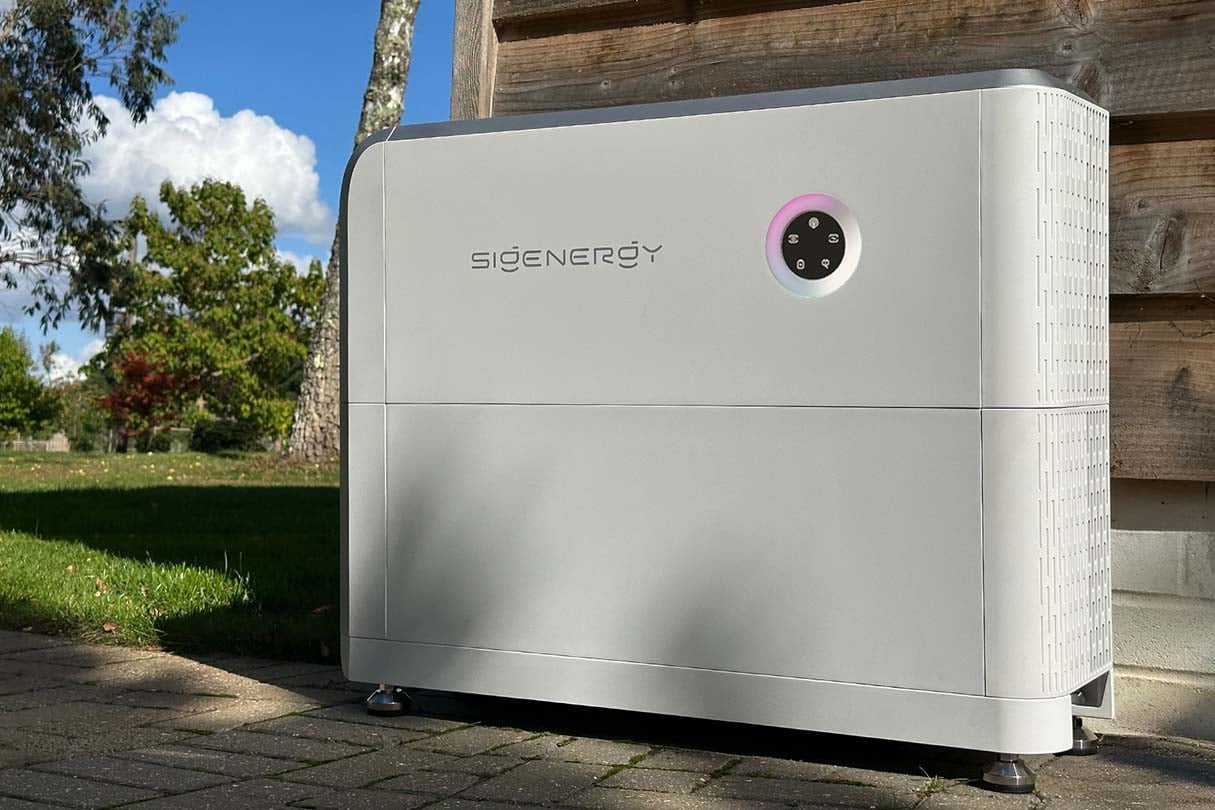
Sigenergy: Inverter, battery and EV module in one stack
Fox ESS: Separate battery and inverter (or the EVO all-in-one)
Warranty
Anker: 10 years (80% capacity floor)
Sigenergy: 10 years, paid extension to 15
Fox ESS: 10 years on EP batteries, 12 on EVO
Power-cut backup
Anker: 0 ms, with the Power Dock Pro
Sigenergy: 0 ms whole-home, with the Sigen Energy Gateway
Fox ESS: Whole-home with Fox's backup gateway, 2 to 3 second changeover
EV charging
Anker: Separate Anker charger
Sigenergy: Built-in DC module, 12.5 or 25 kW
Fox ESS: Separate Fox charger
Weather rating
Anker: IP66, runs from −20 °C
Sigenergy: IP66
Fox ESS: IP65 (EP), with battery warming
Octopus battery-control lists
Anker: Not listed
Sigenergy: Intelligent Flux and Charge Pack
Fox ESS: Intelligent Flux and Charge Pack
Checked against Anker’s, Sigenergy’s and Fox ESS’s UK product pages and datasheets in October 2026. We confirm the exact model and warranty in your quote.
Anker SOLIX X1 vs Sigenergy
Sigenergy is the bigger platform: larger modules, about 54 kWh per stack, single-phase inverters up to 12 kW and a DC EV charger that slots into the stack. Choose Sigenergy if an electric car or heavy usage is in the plan. Choose Anker if space is tight, the battery is going somewhere cold, or you don’t need that much headroom.
Anker SOLIX X1 vs Fox ESS
Fox ESS is the best-known proven option, with big EP12 batteries (11.52 kWh) and a place on Octopus’s battery-control lists. Its whole-home backup gateway takes around 2 to 3 seconds to switch over, where Anker’s Power Dock Pro is 0 ms. Choose Fox for a proven name and closer Octopus integration; choose Anker for the slim build and instant backup.
Our verdict
The Anker SOLIX X1 earns its place in homes where a deeper battery won’t fit, or where it has to live somewhere cold. If space isn’t an issue, EcoFlow or Sigenergy, our two top picks, offer longer warranty options and closer links with Octopus. Book a video call with our technical solar designer, who can design the X1 alongside the alternatives for your roof and show you the numbers side by side.
More detail: Anker SOLIX X1, the SOLIX package, or Sigenergy vs EcoFlow.